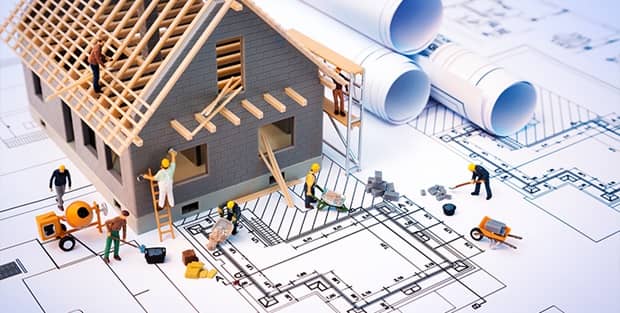
Constructing a home from your own can be a truly thrilling experience — you call the shots when it comes to how, where and in which manner each room is built.
These types of projects, however, can be very expensive… and not even your ordinary mortgage approval will get you out of your down payment and monthly installments.
A home construction loan funds your dream dwelling during its building process, and you’ll need to understand how these financial instruments work when deciding which type of mortgage to choose.
What Is a Home Construction Loan?
Home construction loans allow you to secure a short-term mortgage that will fund the building of your new house.
There are many expenses involved in building a house: land clearings, labor, building materials, permits, designs, blueprints and a contractor — all of which a construction loan covers.
Some companies offering such financing packages also include the purchase of the actual land where you would like to erect your private sanctuary as part of the mortgage contract.
Construction loans differ from standard home mortgages in that they require more information, and assess your creditworthiness relative to financing such an endeavor as homebuilding: that is — the risk of default is far greater for the lender, and thus their requirements are far more stringent.
Typically, a construction loan spans only six to 18 months — by which point the dwelling financed by the mortgage should be completed, and the loan paid back or converted to a long-term mortgage.
The Process of Applying for a Construction Loan
A construction loan typically begins when you first begin designing the layout of your future residence.
Your preferred lending institution will likely require such visuals as the building blueprints and detailed timelines, a comprehensive financial statement, and your signed contract with a chosen professional general contractor.
Lenders will also ask how much funding you’ll likely need at a later closing, which has to do with the expected appraisal value of your new home.
Construction Loan Draw and Interest Payments
Construction loans carry higher rates of interest than standard mortgages due to the risk factor involved at the earlier stages of building.
At the beginning of the construction period, a lender may require monthly payments of interest only, accrued on the portion of the total loan amount disbursed to date.
For example, if your lender has approved you for a $400,000 but only $ but up to this point — just 100,000 has been transferred to your account, you may not be charged interest based on the amount of the entire 200,000, but rather on the amount that has been dispensed so far for your project’s renovation — that is, the 100,000.
Your interest accruals will, of course, increase as additional funds are transferred per the draw schedule.
Some lending entities allow roll-over of construction-loan interest costs into the overall cost of homebuilding, whereas others require regular principal and interest payments for the life of the loan — clarification is in your best interest before signing any paperwork.
Other major points of clarification concern such issues as:
Types of Home Building Loans

• In construction-to-permanent loans, you only make one set of payments — those which are due on the mortgage for your construction loan during the building process.
Upon completion, the financing converts to a traditional long-term mortgage – no need to close twice: this decreases costs, hassle and time involved.
• Stand alone construction loans (two-close loans) provide a loan which funds only the building process.
A separate mortgage will be issued upon completion so that the construction loan can be repaid.
Though more flexible, this option requires you to both close twice and come up with extra funds to cover the costs of the two closings.
• Renovation construction loans finance work on an existing dwelling.
Such improvements as additions, remodeling or whole-house additions (kitchen, appliances, solar panels etc.) are all eligible for such loan proceeds.
This type of construction loan is usually based on an appraisal of the updated value of the improved dwelling.
What your Potential Lenders Will be Looking At
Due to the risk factor of a construction loan, lenders demand far more in terms of documentation.
Having a stellar credit rating goes a long way towards getting approved for such a mortgage, as well as having enough income to cover principal and interest payments upon loan maturity.
One area in which you should concentrate on is the general contractor to whom you intend to turn to when building (or renovating) your dwelling.
Your potential lender may request details about the contractor you’re considering working with.
Lenders will assess your construction budget to determine their risk; a line item breakdown for labor, materials, permitting, landscaping and any other expenses associated with building may be requested in detail.
A contingency reserve (often amounting to approximately between 10 to 20%) is another vital feature of your construction budget, to cover unexpected costs such as material costs increases, or delays.
The lender will then assess the value of the completed home as outlined in the building contract and blueprints.
Should said valuation fall below the requested loan amount for any reason, you may be asked to increase your down payment, or modify the details of the renovation.
Pros and Cons of Building a Home With a Construction Loan
A construction loan offers many advantages.
It provides much needed funding towards the building process, and construction-to permanence loans allow you to cut costs by only closing once.
Such a mortgage option also allows you to only make interest-only payments during the building process.
On the downside, construction loans come at much higher risk: construction projects can be delayed for any number of reason, extending your interest-only payments or requiring additional living expenses if you will be living elsewhere during the time frame when your residence is still under construction.
Material costs tend to shoot up, and your project can easily balloon out of your original budget if you want to update the interior design.
Most lenders do not allow you to raise the limit of your construction loan if your costs exceed the original estimate – and you’ll be required to come up with the difference.
Compare rates, closing costs, draw schedules and inspection and repayment requirements amongst multiple lenders.
Also, make sure to read the fine print regarding loan closure if work is not completed on time.
How to Prepare for Your Closing Appointment
Create a contingency reserve budget at 10-20% above your construction costs for unexpected expenses.
Choose a competent contractor and make 100% certain that the contract reflects the exact build specs you require, and outlines both parties’ obligations and financial liability under change orders and delays in the schedule.
Make sure to have your financial documents in order when you speak to a lender about a construction loan – they will include such staples as tax returns and W-2 forms, bank account details, information about debts, and verification of your funding for the down payment.
Do not take on greater amounts of debt or get new credit cards just for applying: changes in your debt-to-income ratio can affect your approval chances.
It is always a good idea to have a basic understanding of the costs and legal formalities of obtaining the required permits and utilities for your planned building before your closing.
Tips for a Smooth Construction Process
Remember that lenders will request detailed information about your contractor and building plans and blueprints before issuing funds — a good contractor can help ensure a smooth construction process.
Plan financially: Set a budget which accounts both for labor and material costs.
Set a schedule — having a timeline for the completion of works ensures a smooth building process and serves as a good reference for your lender in terms of the disbursement timing and size of funds.
Know Your Exit Strategy
Most construction loans either become long-term mortgages on the property (the case with construction-to-permanence loans), or can be paid back upon completion by obtaining a standard mortgage.
It is important to clarify these conditions with the lender before signing your contract – if the terms were verbally explained to you, put them in writing.
A smooth construction process is a large part of a happy lending experience. Home construction loans function differently to standard mortgages in that they finance a building project — not an already-standing residence. It is in a borrower’s best interest to research several lending companies as far as interest rates, disbursement processes, inspection requirements and any additional costs go, and understand the repayment and conversion terms of such a mortgage.