A personal loan can be a great way to help you manage large expenses, consolidate debt and manage unexpected requirements. However, once you have taken out a personal loan you will have to start making regular repayments. Whilst you may know how much you need to pay each month, the interest rate and duration of the loan, you might not be aware of what personal loan foreclosure is.
A personal loan foreclosure means you are paying off your personal loan ahead of the agreed end date. This can mean you become debt free faster and you may save on interest in the future. However there might be some charges involved.
Understanding how personal loan foreclosure works can help you decide if it is the right option for you.
What is a Personal Loan Foreclosure?
A personal loan foreclosure (or early repayment/prepayment) means you repay the outstanding balance of your loan ahead of the agreed loan duration. You will pay the full outstanding principal to your lender plus any interest, fees and charges.
For example, if you took out a 5 year personal loan, but received a bonus after 3 years you may want to repay your outstanding balance ahead of schedule. You can pay the required amount to your lender and they will close your loan account.
A personal loan foreclosure is different to a partial prepayment. Partial prepayments will reduce the principal of your loan. A personal loan foreclosure means you are closing your loan completely.
How Does a Personal Loan Foreclosure Work?
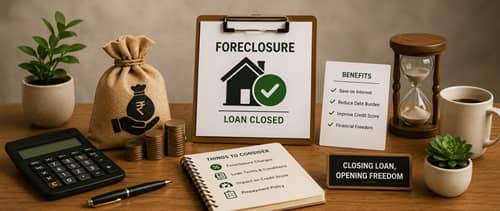
Whilst the exact process may vary depending on your lender, the process will generally be similar.
Contact your lender and ask them to provide you with a personal loan foreclosure statement. This will detail how much principal you owe, interest owed, any charges for closing your loan and tax.
Carefully look through the statement and ensure that there are no outstanding payments, late payment charges or extra fees. If the amount you owe isn’t clear, ask your lender for a breakdown.
Once you have confirmed the amount you need to pay, pay the amount using your preferred method. This can be done online, via cheque, demand draft or branch.
Once you have paid the amount, ask your lender for a loan closure letter or no dues certificate. This will confirm that you no longer have any liability to your loan. You should also ask for any relevant documents. This can include returning security documents.
After some time, check your credit report to ensure that the loan is marked as closed. Keeping a record of all your documents can help if there are any issues.
When Can I Foreclose My Personal Loan?
Many lenders will not let you close your loan immediately after taking out the loan. There may be a lock in period which means you need to make a certain number of payments before requesting to close your loan early. This can vary depending on your lender, loan and the terms of your agreement.
Some lenders may only allow you to close your loan after 6/12 months. It is important to check if your lender allows you to close your loan early and what their policy is. This can be found in your loan agreement.
You may also find that your loan agreement will state how many partial prepayments you can make, the minimum amount you can pay and any charges. This will help to avoid any unexpected charges.
What are Personal Loan Foreclosure Charges?
Some lenders will charge a fee to close your personal loan early. This will generally be a percentage of your outstanding principal. The percentage may reduce the closer you get to the end of your loan term.
For example, your lender may charge you a higher percentage in the early years and a reduced percentage towards the end of your loan. Some loan agreements may state that tax will be applied to the charge.
The total you will pay to close your loan can include:
Outstanding principal.
Interest owed.
Charge/Prepayment.
Taxes.
Late payment charges.
Administration and documentation fees.
As charges can vary greatly, do not assume that you won’t be charged any fees. Always ask your lender to provide you with a quote.
Benefits of Closing Your Personal Loan
The main benefit of closing your personal loan is you may save on future interest. Personal loans are typically fixed monthly payments. This means you will be charged interest on the loan. Closing your loan early means you may not have to pay as much in interest.
Closing your loan can help reduce the stress of having to make a monthly payment. You will no longer have to make that payment so may find it easier to manage your household budget, save some money or achieve your goals. It can also be helpful if you have a high interest rate.
Closing your loan can help you manage your debt. Your debt will be reduced and you may improve your financial situation. Whilst it will not necessarily improve your credit score straight away, having your account properly closed can help improve your credit history.
You may feel a sense of relief knowing you have paid off your loan early. You may feel you have more control over your finances.
Disadvantages of Closing Your Loan
Although there are benefits to closing your personal loan, it may not always be the best choice financially. Firstly, you will need to have lots of liquid cash to pay the full outstanding balance. This can cause issues if you use up all your savings to close your loan and then have no money for emergencies.
Ensure you have enough in your emergency fund to cover your essential expenses for a few months before closing your loan. It may not be wise to use up all your savings.
You may not save as much as expected due to charges. If there is a short amount of time left on your loan, you may not save much on interest. You may end up paying more in charges and tax.
There is also an opportunity cost. The cash you use to close your loan could be used to invest, pay off more expensive debt or go towards a key financial goal. This will depend on the interest rate of your loan, your investment options and your risk appetite.
You should also consider if you have any other high interest debt. It may not be the most efficient to pay off your personal loan but leave expensive credit card debt.
How to Decide if Closing Your Loan is Worth it
To decide if you should close your personal loan, you need to calculate how much it will cost to pay off early.
Start by calculating how much interest you will pay on the remaining payments. Your lender may provide you with an amortisation schedule in your loan or on your loan statement. This will show how much principal and interest you will pay.
Calculate how much it will cost to close your loan. This can include:
Outstanding principal.
Charge.
Tax.
Outstanding interest.
Other administration costs.
Calculate how much you could save by subtracting the cost to close from how much you would have paid in interest. If you are not saving much, it may be better to pay as normal.
For example, if you had $1000 of interest to pay but the charge and costs to close were $250, you could save around $750. However, you should also consider if you will be using up your savings.
If you have a complex calculation, you can ask a financial advisor or your loan representative to help you.
Key Things to Consider Before Closing Your Loan
Ensure you are in a stable financial situation. If you have a steady income, enough savings and no pressing financial commitments, it may be the right option for you. However, if you have an uncertain income or expect to have large expenses soon, it may not be the right option.
Look through your loan agreement to see if there is a lock in period, charge, minimum repayment requirements and any required documentation. Ensure the amount quoted is only for a specific date as interest may still be building up.
Whilst closing your personal loan generally won’t have a negative impact if it is reported correctly, your credit score may be affected by changes in your credit mix, age of accounts and borrowing history.
Try not to borrow again straight away. If you close your loan and then take out another loan quickly for non essentials, you may not gain much from it financially in the long run.
Documents to Obtain After Closing Your Loan
Once you have closed your personal loan, you should obtain all your documents relating to the closure. This can include:
Loan closure letter.
No dues certificate.
Final account.
Receipt.
Updated repayment history.
Your documents will be returned/released.
Ask your lender how long it will take for your loan to be marked as closed on your credit report. After this time, check your credit report. If it is still showing as active or the balance is incorrect, contact your lender and credit bureau.
Having these documents will help protect you in case of any issues.
Common Errors
Assuming the amount you owe is just the principal on your statement. There may be additional interest and charges.
Not asking for a written statement. This can cause confusion if you have to wait a few days for your payment to be processed.
Not considering the lock in period with your lender. You may try to close your loan too quickly and get declined or charged.
Using your emergency funds, pension or borrowing to pay off your loan can cause issues. Ideally you should use any extra money.
Don’t forget to check your loan is marked as closed on your credit report.
Conclusion
Closing your personal loan can be a great way to save on interest, simplify your finances and become debt free quicker. However, there are a few things to consider before deciding.
Ask for a detailed personal loan foreclosure statement, understand any charges, have an emergency fund and work out if you will save much. Once your loan has been paid off, obtain your no dues certificate. If you think through your options,
personal loans can be closed